IRS Guidance on 20% Business Income Deduction

LOUISIANA REALTORS • August 9, 2018
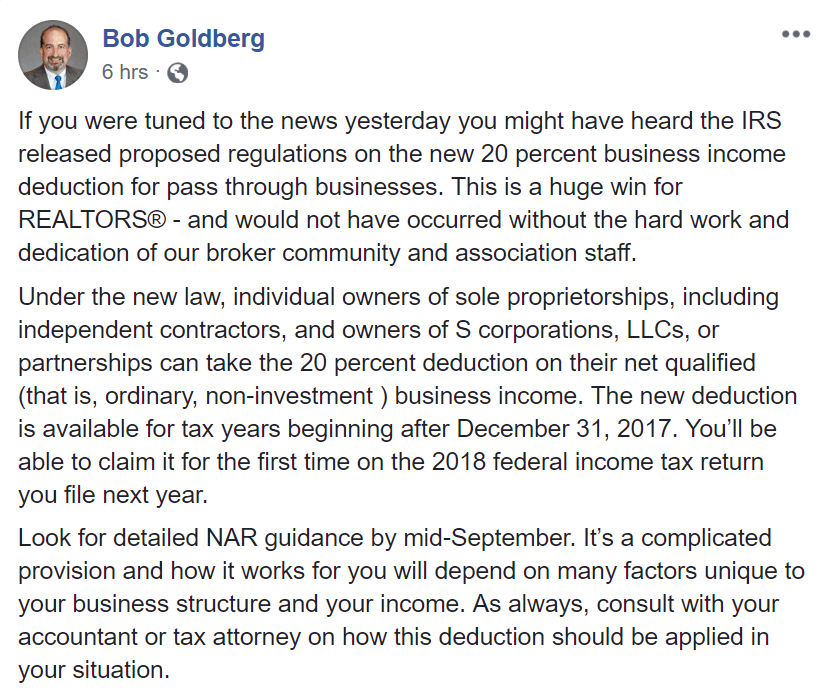
The Internal Revenue Service issued proposed regulations for a new provision allowing many owners of sole proprietorships, partnerships, trusts and S corporations to deduct 20 percent of their qualified business income. The new qualified business income deduction is available for tax years beginning after Dec. 31, 2017. Taxpayers can claim it for the first time on the 2018 federal income tax return they file next year.

The deduction will have a significant, beneficial impact on NAR’s membership. The National Association of Realtors® believes that this deduction, included in today’s IRS and Treasury Department release of proposed regulations, will be available to a wide range of real estate professionals, including those who are self-employed as well as those operating through partnerships, LLCs, and S corporations. Here is what Bob Goldberg, NAR CEO had to say about it: 
CONTACT US
By Louisiana REALTORS® August 5, 2026
 Candidate qualifying for Louisiana’s November 3 election began Wednesday, August 5, and concludes Friday, August 7. The three-day qualifying period will establish the candidates for all six U.S. House districts, as well as judicial, parish and municipal races across the state. This election cycle includes several changes to Louisiana’s congressional races and election calendar. The state’s U.S. House primaries, originally scheduled for May 16, were canceled following the U.S. Supreme Court’s decision in Louisiana v. Callais. The Louisiana Legislature subsequently adopted a new congressional map that reduced the number of Black-majority congressional districts from two to one. Under the revised election calendar, the November 3 U.S. House contests will use an open primary system. All qualified candidates will appear on the November ballot, regardless of party affiliation. A candidate receiving more than 50% of the vote will be elected. If no candidate receives a majority, the two candidates receiving the most votes will advance to a December 12 runoff. U.S. Senate The November general election will feature Republican nominee U.S. Rep. Julia Letlow and Democratic nominee Jamie Davis. Letlow's Senate campaign has also created an open seat in Louisiana's 5th Congressional District. 5th Congressional District Several candidates have announced campaigns for the 5th Congressional District seat: State Sen. Stewart Cathey State Rep. Michael Echols Louisiana Board of Regents Chair Misti Cordell State Rep. Gabe Firment Cathey, Echols and Firment currently serve in the Louisiana Legislature. Additional candidates may qualify before the deadline on Friday. The 5th District covers portions of northeastern and central Louisiana and extends into the Florida Parishes. 6th Congressional District Congressman Cleo Fields has announced that he will not seek reelection in the newly redrawn 6th Congressional District. Instead, Fields is running in a special election for his former state Senate seat, which became vacant following the death of Sen. Larry Selders of Baton Rouge. The newly drawn 6th Congressional District extends around the Baton Rouge area and includes portions of rural communities surrounding the capital region. State Sen. Rick Edmonds has announced his candidacy. State Sen. Blake Miguez has also been discussed as a potential candidate, although the candidate field will not be finalized until qualifying closes Friday. Federal law requires congressional candidates to reside in the state they seek to represent but does not require them to reside within the specific congressional district. 2nd Congressional District Congressman Troy Carter currently represents the 2nd Congressional District, which extends from the Baton Rouge area toward New Orleans. Under the newly adopted congressional map, the 2nd District remains Louisiana's sole Black-majority congressional district. East Baton Rouge Parish Judiciary All 15 judgeships on the 19th Judicial District Court are scheduled for election following the Legislature's creation of two new judicial election subdistricts. Each subdistrict will elect seven judges, with an additional judgeship elected parishwide. Litigation challenging the new judicial map remains pending. Judicial races are among the contests being monitored by Louisiana REALTORS® and local Political Action Teams. Judicial decisions can have implications for property rights, business activity, litigation and the overall legal environment in Louisiana. Local Elections Voters across Louisiana will also consider candidates for mayors, city and parish councils, school boards, police chiefs and other local offices. While these races typically receive less statewide attention than congressional and statewide contests, local elected officials make decisions affecting land use, zoning, permitting, infrastructure, taxation and housing policy. These issues can directly affect real estate activity and development within local communities. Candidate Lists and Election Information The candidate field will not be final until qualifying closes Friday, August 7. The official list of qualified candidates is available through the Louisiana Secretary of State's Candidate Inquiry portal. The complete election schedule, including key dates for voting, registration and absentee ballots, is available through the Secretary of State's election calendar. For Louisiana REALTORS®, the qualifying period provides an early look at the candidates who will appear on the November ballot and the races that may affect real estate, property rights, development and local communities across the state.
By Louisiana REALTORS® August 5, 2026
The Louisiana REALTORS® Board of Directors will elect six (6) LR At-Large Directors at its October 1st meeting. Qualifications and an application for the position can be found below.
By Louisiana REALTORS® August 5, 2026
From the Louisiana Department of Insurance: Insurance Commissioner Tim Temple recognizes fire districts that have received improved fire ratings since last year. Improved fire ratings lead to reduced fire insurance premiums for property owners in the associated area. “Improved fire protection ratings demonstrate the hard work and dedication of fire departments and community leaders. These improvements make homes and communities safer and can reduce fire insurance premiums,” Commissioner Temple said. “Some premium reductions are more than others, but any improvement to the safety and resilience of our communities is a win for everyone.” Fire protection grading is promulgated by the Property Insurance Association of Louisiana (PIAL) and approved by the Commissioner of Insurance. All fire districts are graded on a scale of 1 to 10 by PIAL, with 10 representing no fire protection and 1 representing the best level of protection. The PIAL considers several factors when determining a district’s grading, including the number of dispatchers on duty, the number of firefighters and fire trucks and the availability of water. “I’m extremely proud of the Louisiana Fire Service,” said Department of Public Safety Principal Assistant Chief Bryan J Adams. “They continue to step up, work hard and deliver exceptional service to protect our community. As we partner with them through training and the enrollment support they need to succeed, you can expect continued results like this. Our office is committed to staying at the forefront of collaboration with the Louisiana Fire Service—because we’re truly One Team.” Policyholders in the affected areas should contact their insurance producer if they have questions about how fire rating improvements may affect their fire insurance premiums.  The average annual premium reduction examples below are calculated for a brick masonry home with an HO-3 policy insured for $250,000, with a $500 deductible.
Show More